
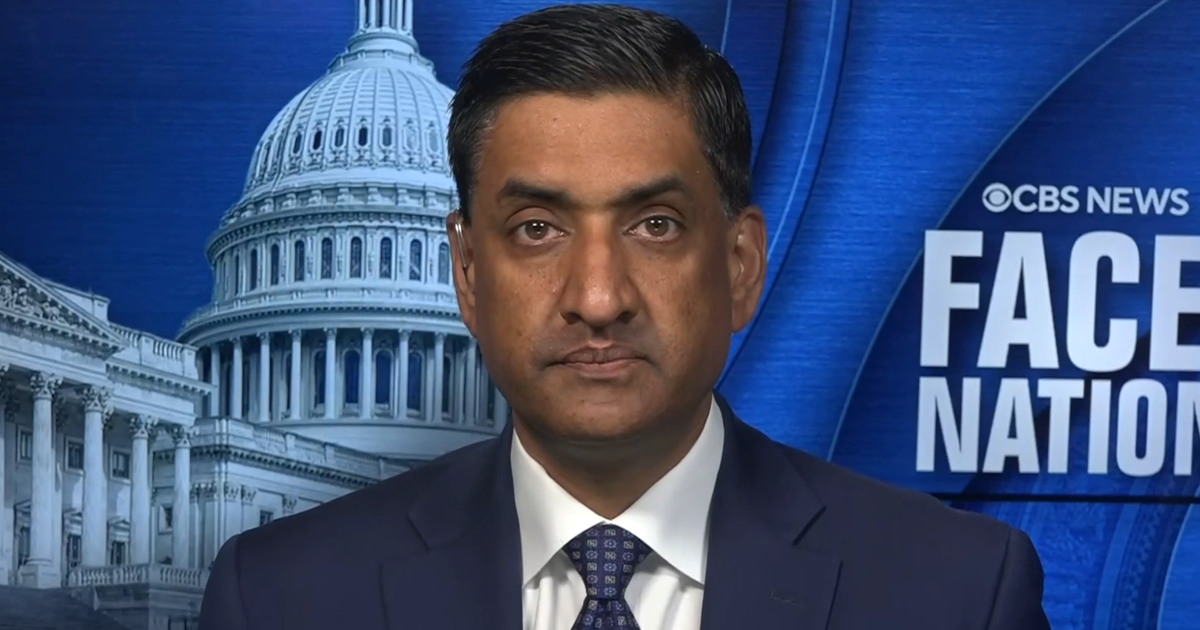
During a September 20, 2026 appearance on CBS News’ “Face the Nation,” California Congressman Ro Khanna, the senior Democrat on the Select Committee on the Chinese Communist Party, discussed the escalating artificial intelligence rivalry between the United States and China, alongside pressing concerns regarding detained Americans.
Khanna highlighted his recent outreach to major Chinese technology firms, including DeepSeek and Alibaba, urging them to emulate American companies like OpenAI and Anthropic in slowing the pace of AI development to allow society time to establish adequate safeguards. The congressman described the pursuit of an AI arms race as akin to nuclear war, warning that such a conflict would be catastrophic for civilization.
Despite these appeals, Khanna confirmed that none of the targeted Chinese firms have responded to his proposals. He emphasized that the primary dangers of AI lie in the potential loss of control or its misuse, alleging that Chinese entities have taken no action to mitigate either risk.
When questioned by host Margaret Brennan about the feasibility of collaboration given warnings from the FBI, NSA, and CISA regarding industrial-scale technology theft by Chinese firms, Khanna acknowledged reports of “distillation,” or copying of American models. He argued this reality underscores the need for both domestic regulation and an international accord with Chinese leadership.
Khanna outlined specific requirements for such a treaty, including international monitoring and verifiable checks at data centers to distinguish between model training and inference. He cited former President Ronald Reagan’s principle of “trust and verify,” noting that similar arms control agreements have been successful in the past.
Addressing China’s planned $300 billion investment in state-operated data centers over the next five years, Khanna acknowledged the blurred lines between the Chinese state and its industries. He insisted that the immediate priority must be a direct agreement between President Trump and Xi Jinping, focusing on two core principles: a ban on recursive self-improving AI and strict safeguards against the use of AI in biological or nuclear weapons.
The conversation also turned to domestic policy, with Khanna calling for the creation of an independent federal AI agency modeled after the Food and Drug Administration. He criticized the notion that AI regulation is too complex for Washington, pointing to successful regulatory frameworks in nuclear energy and aviation. While noting alignment with President Trump’s interest in a dedicated AI authority, Khanna expressed concern over potential offensive applications, citing the incident involving AI-fed information in the shooting of an Iranian school.
Finally, Khanna addressed the wrongful detention of Min Zin, a constituent and scholar held by Chinese authorities for 100 days without legal access. Standing in solidarity with Secretary of State Marco Rubio, Khanna condemned the disappearance of Americans abroad and emphasized the need to keep human rights abuses, including those against Uyghurs, at the forefront of diplomatic discussions.


Ten0 days without legal access is unacceptable. Diplomacy on AI regulation shouldn’t come at the cost of abandoning detained citizens.
A nuclear-style treaty for AI seems ambitious, but if China ignores our companies, what leverage do we actually have?