
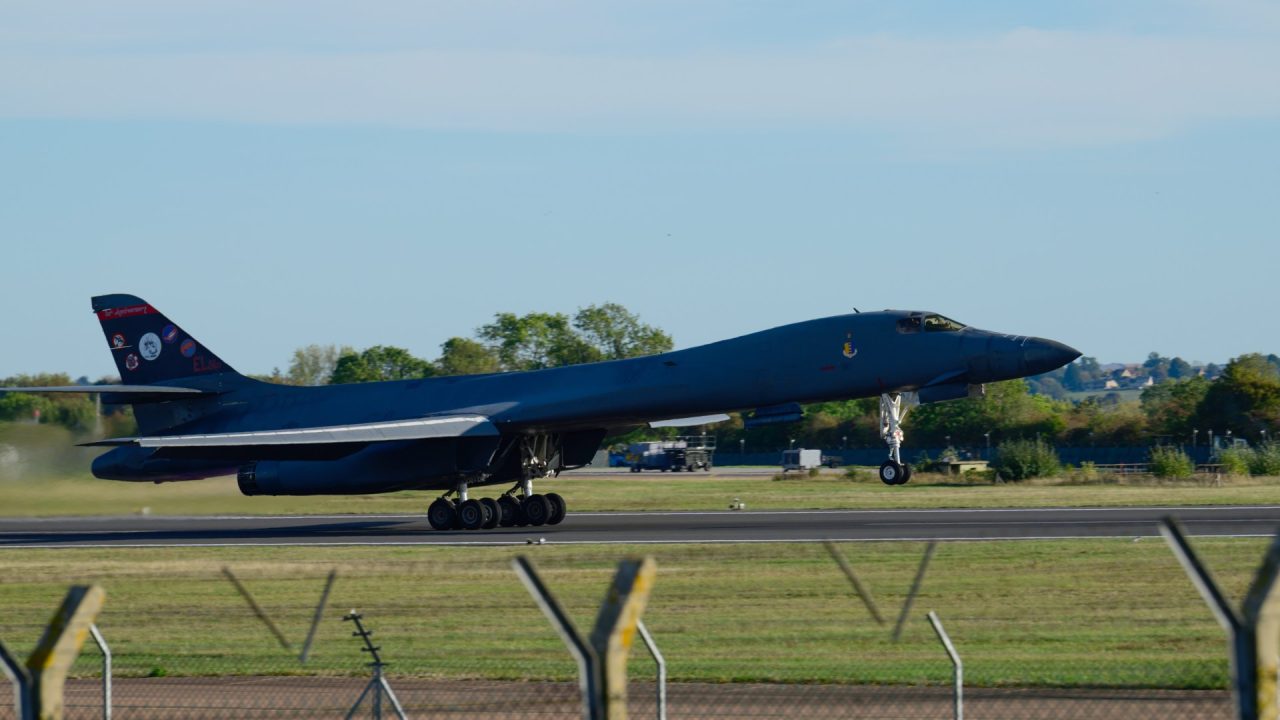
The United States has rapidly relocated its B-1 bomber fleet from the Royal Air Force base at Fairford in the UK, a decision driven by heightened security fears following a thwarted plot to attack the facility. The withdrawal comes shortly after a British bomb disposal robot was deployed near the base and 85 nearby residences were evacuated due to the perceived immediacy of a potential strike.
Approximately a dozen B-1 bombers had been stationed at the airfield, serving as a strategic launchpad for operations against Iran in the ongoing conflict. Although the incident resulted in no charges and the subsequent release of five suspects, along with a separate British-Iranian individual, Washington cited concerns over additional potential attacks as the primary reason for pulling its forces.
Tehran has denied any involvement in the alleged conspiracy targeting the base. Despite the retreat of the bombers, analysts emphasize that the move diminishes, rather than eliminates, Washington’s ability to conduct sustained bombing campaigns against Iran.
Dania Thafer, executive director of the Gulf International Forum and a lecturer at Georgetown University, stated that while the US has lost a convenient forward operating location, it has not lost its fundamental strike capability. However, she noted that the absence of these aircraft could complicate prolonged aerial operations depending on the positioning of other military assets.
Christoph Bergs, an analyst at the Royal United Services Institute, described the Fairford deployment as a method for the US to rapidly surge sorties. He explained that the bombers were officially stationed there for defensive purposes at the request of the UK government, likely with a limited targeting list. Their removal reduces the immediate threat level and the speed at which the US can generate air strikes.
Arun Dawson, a PhD candidate at King’s College London’s Freeman Air and Space Institute, highlighted the tactical disadvantages of the withdrawal. He noted that the B-1 is uniquely suited for long-duration campaigns due to its massive conventional weapons payload of at least 34 tonnes—significantly more than the stealth-focused B-2. This capacity makes it particularly effective for striking air defense systems, ballistic missile sites, and Islamic Revolutionary Guards Corps facilities over multiple targets.
With the B-1s gone, the US may need to rely on longer-range missions from American soil or distant bases, increasing flight times, crew fatigue, and the logistical demands for aerial refueling. Dawson suggested the abrupt departure indicates specific threats were directed at the aircraft, their crews, or the base itself, and that Washington may have calculated that temporary withdrawal better protects future operational readiness.
David Des Roches, a former Pentagon official and professor at the Thayer Marshall Institute, argued that the risks at Fairford outweighed the benefits. He pointed out that the bombers were parked only about 275 meters from public viewing areas, leaving them vulnerable to drone or mortar attacks. While acknowledging the loss of some operational ability, he criticized the lack of overhead cover for US aircraft globally.
If the bombers are redeployed, the US has two primary alternatives: Diego Garcia, a remote British Indian Ocean Territory hosting a joint US-UK base, or various military installations in the Persian Gulf. Diego Garcia offers greater security from Iranian retaliation but requires longer flight distances. In contrast, basing in the Gulf would shorten transit times and reduce tanker requirements, though it presents higher risks given that Gulf nations have already borne the brunt of Iranian counterstrikes.
Thafer described RAF Fairford as a useful middle ground between these two extremes. With that option no longer viable, Dawson identified Diego Garcia as the more obvious choice due to its secure environment and infrastructure designed for large-scale air operations.
For now, the withdrawal appears to blunt US bombing capacity rather than remove it entirely. The practical impact will depend on whether the administration deems further strikes necessary in the near term. Meanwhile, the expected arrival of the Theodore Roosevelt carrier strike group and the Makin Island Marine Expeditionary Force in the Middle East by November will bolster regional air power.
Dawson noted that while carrier-based fighters cannot match the B-1’s payload, their numbers provide commanders with additional options for shorter-range strikes. The episode underscores the vulnerability of US alliances and overseas basing networks, which are critical for rapid power projection. If such bases face attacks or political restrictions, the implications could reshape how the US military structures its forces and sustains operations globally.


The mention of drone and mortar vulnerabilities is exactly why I never trusted the presence at a civilian-adjacent base.
Does this actually slow down US strikes significantly? B-1s are unique, but isn’t there plenty of redundancy elsewhere?
Security at Fairford was always questionable. Parking bombers 275 meters from public viewing areas seems reckless.